DIY Book Covers

The largest project my husband and I have done in our house is the built in entertainment center for our first floor. It took lots of brainstorming and planning to make this from scratch, but we are beyond thrilled with the results.

After it went up, we quickly filled it with books and some baubles that went with our sailing/nautical-lite theme.  As the months went by, I found myself tinkering with the items on the shelves as well as the layout… I was just not pleased with how it looked.

P1030475

Here’s a close up of the shelves— they were too cluttered/a bit too full for my liking. We used a textured wallpaper (similar to grass cloth) for the back of the bookshelves—I wish it photographed more like it actually looks! Forgive the TV wires… we haven’t put them through the cabinets yet!

Optimized-before up close


After de-cluttering and shifting some things around, I found a layout that I could live with.

P1030483 

Now that I liked how the shelves were more open, I wanted to make the whole thing blend together. I was not a fan of the mishmash of cover colors and wanted to do a subtle theme of blues, greens, and creams—this would match much better with the rest of the décor in the room.

My husband thought I was insane when I told him I was going to recover the books. When I removed the paper cover, some of the hardcover books were already blue or cream, so that worked to my advantage. It was mostly the paperbacks that I had to deal with.

As I wanted to print on the covers, I referenced/modified this in depth tutorial from the blog The Precious Little Things in Life.

Here’s how I covered my books.


What you need:

Books

Paper (I found some large paper at Hobby Lobby and used brown shipping paper that I  

             already had leftover from Christmas)

Scissors

Tape

Measuring Tape

Ruler

Printer

Microsoft Word

photo 1 


Step 1:

First I had to determine what color I wanted each book to be. I did a rough sketch of our books in the layout that I liked and then assigned each book that was getting covered a color.

Step 2:

Line up your books and group those of the same height together. Under each category of height, I listed the individual measurements for those titles.

Step 3:

Measure your books. You need two measurements, the height of the book, which you already measured, and the book’s circumference. Find the book’s circumference by placing the lip of your measuring tape on the backside of the book, wrap around the spine, and across the front cover.

photo

When you have all of these written down, you are ready to start covering your books. It would have been lovely if I had books that were the same height and circumferences, but alas every book was slightly different. This would have saved me some time cutting out the paper (I could have cut multiple sheets at once). Maybe you will be luckier than I was.

Step 4:

These directions might vary ever so slightly for you, as I was using Microsoft Word 2011 for Mac. In Microsoft Word, navigate to Page Set Up.

file page setup

In the Page Set Up box, find Paper Size, and go to Manage Custom Sizes—this is where you will type in your measurements to ensure a perfect fit.

In the Manage Custom Sizes box, the Width box is where you will type the height of the book. The Height box is where you will then type the circumference  measurement. You can see this in the picture below, as well as the fact that I chose to make my top, bottom, left, and right margins 0.
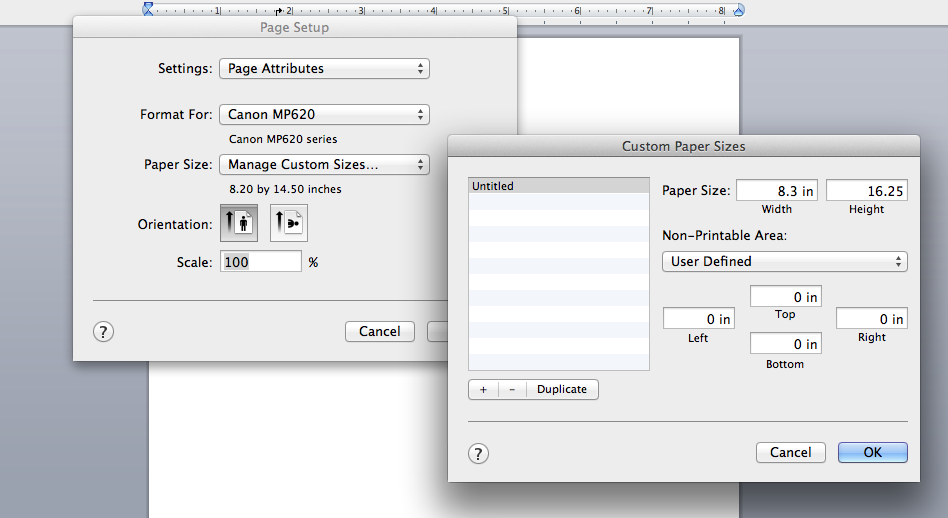
page setup

Your page will now look tall and narrow—this is what you want in order to print the title.

Step 5:

Now that you know your page dimensions, you’re ready to cut your paper. Cut your paper to the same measurements that you typed in the Width and Height boxes. Once your paper is cut, put it in your printer (I had to use the manual feed tray in the back of mine).

beo

Step 6:

You’re almost ready to type your book title onto the spine of your book cover.

You can vary the fonts and sizes to your liking—I chose to keep my font the same for every book. The only thing I changed was the font size. Some of my book spines were 2 inches while others were ¼ inch, therefore I used size 30 font for the bigger titles and size 14 font for the smaller. I printed out one regular old page of a few titles with font sizes of 14, 18, 22, 26, 30. I then held up this sheet to the books when I was ready to type the titles in order to eyeball which size was the best fit.

Step 7:

Remember where you typed the circumference of the book into the Height box? In my earlier photo it was 16.25. In order to type your title perfectly centered on your book cover, you need to take your circumference measurement and divide it by 2.

For example, 16.25/2 = 8.125.  Hit enter until you bring your cursor down to roughly 8.125. So long as you are in the ballpark of that number, you will be fine.

Center your cursor, and type in your title and author.

centered text

Step 8:

With your paper in the printer and title typed up, go ahead and print.

Lay your book on the printed paper and pull until the title is centered on the spine. 

photo 3

Make a crease where the front/back covers end so you know where to fold your paper. Tape the cover in place.

covering

Step 9: (Optional)

I decided to lightly pinch/crease the spine so there was more definition around the edges.

covered books 

So there you have it– freshly covered books to go with the color scheme of your choice. Here are a few shots of the books on the shelves. (Pardon the wonky lighting in a few of the photos).

 P1030494

P1030503 P1030498

 P1030490

P1030487

Although it took a while, I enjoyed doing this project. It was kind of like a grown up version of covering your textbooks back in middle school! 


Painting Kitchen Cabinets Part 1

For about as long as I have been nagging my husband to let me paint our kitchen cabinets, I have been researching everything there is to know about painting kitchen cabinets (read: pinning copious images on Pinterest. Seriously, what did I do before Pinterest?)

There are a ton of options, and tons of opinions and supporters for each option.

Lisa painted her kitchen cabinets with Rust-Oleum Transformation three summers ago. She enjoyed the finished product, but she said it took some time, which is not always something I have ample amounts of with two young whippersnappers running around the house.

Liz the of naptimedecorator.net did the real deal and primed and painted. Her kitchen is as dear as can be.

And Sherry and John broke down their 15 day kitchen cabinet painting project (15 days!?!). Their results are awesome; their kitchen turned out gorg. If I had the time/patience, I might have considered that route, but I didn’t.

Instead,after reading about satin and flat finishes, cabinet coat, poly, wax, etc, I chose to go with Annie Sloan Chalk Paint, and here is why.

Annie Sloan Chalk Paint is awesome because there is virtually no prep work involved (aside from a good old scrubbing of your cabinets). This means no sanding and no priming, which was a huge selling point for me.

The paint itself is a little pricey, but it really goes a long way!

Painting was a breeze because of this paint and Lisa. Somehow Lisa agreed to help me (thanks, Liser!). With Lisa’s help, she and I managed to paint all the cabinets in less than 6 hours, which I think it pretty stellar. Now, before you run out to your nearest ASCP retailer, please keep in mind that I was not finished because I still needed to wax the cabinets (more on that later). 

Here are some before shots of my very ugly kitchen cabinets. Can you understand my constant desire to paint these suckers?

IMG_5134IMG_5127Horrible right?

Lisa and I made the executive decision to leave the doors on the cabinets and paint the hinges. Now, I know most of you must shake your heads at me, but I wanted to see what it looked like, and if I hated it, I figured I could just put new hinges on later.

Here are some during shots…

IMG_5141This was just after the first coat of paint. I was getting a little nervous, but Lisa was quite the ray of sunshine. We pushed on.

IMG_5142I wanted to have a two-toned kitchen. Grey base cabinets and White uppers. This is after the first coat. Lisa and I both said this finish would be good for a beach cottage’s kitchen.

IMG_5148Here is what the cabinets looked like after two coats of paint. Excuse the mess; this isn’t the big reveal. Vast improvement, right?

IMG_5145

Now, I loved the two-toned look, but when Ethan came home, he wasn’t too keen on it. Now, after some soul-searching and texting with Lisa, my mom, Rona, Katie K, Bailey, and Carrie, I decided to be a good wife, and change the upper cabinets to match the base cabinets. I figured he was kind enough to put up with my nagging, etc. that I should listen to his opinion. That’s love, people!

Stay tuned for my next post, where I talk about waxing (my cabinets, silly) and revealing updates on the kitchen.

In the meantime, weigh in with whether you liked the two-toned kitchen or agree with my husband.


P.S. Are you ready to take the ASCP plunge? Check out The Purple Painted Lady–her site is informative, and she is super helpful


Bangin’ Banana Bread AKA Banana Breakfast Cake

IMG_5216 

Here in this house, my boys like to and request to  eat “cake” for breakfast, and if you have a picky eater like my oldest, you would gladly oblige this request because the alternative is air (seriously, I do not know how he has energy). Before you start envisioning slabs of cake with mounds of buttercream icing served up to my kiddos at 7 am, let me clarify that I “healthy up” my “cakes” for breakfast and no one (read: my kids) is the wiser!  

IMG_5222

The recipe for my Bangin Banana Bread or “Banana Breakfast Cake”  as my boys call it, uses whole wheat flour, coconut oil, and substitutes a bit of the need for sugar and oil with apple butter. You can always adjust the oil and sugar ratios by using more apple butter or applesauce. 

IMG_5242

Ingredients for Bangin’ Banana Bread

2 Eggs 

1/3 Cup of Milk

1 tsp of Lemon juice (freshly squeezed or from the bottle)

1/2 Cup of Coconut Oil 

1 1/4 Cup of Mashed Ripe Banana

2 tsp of Vanilla Extract

1 Cup of Sugar

1/4 Cup of Light Brown Sugar

1/4 Cup of Apple Butter (if you don’t have Apple Butter, use Apple Sauce)

1 3/4 Cup of Whole Wheat Flour (or All Purpose)

1 1/2 tsp baking soda

1/2 tsp of salt

1 cup of Semi-sweet chocolate chips

Directions:

1. Preheat Oven to 340 degrees

2. Grease your loaf pan OR line the bottom of the pan with parchment paper and grease the sides. 

3. Beat Eggs in a large bowl

4. Pour the milk and the lemon juice in a measuring cup or bowl– sit for two minutes— essentially you are making the equivalent of buttermilk. 

5. Combine and Beat the Coconut Oil and Eggs together.

6. Add Vanilla, Apple Butter, and Milk Mixture to the egg and oil mixture– beat

7. In a separate bowl, whisk sugar, flour, salt, and baking soda together (you can sift, but I prefer to whisk– it has the same effect). 

8. Stir dry ingredients into the wet ingredients– mix until the mixture is combined (don’t over mix)

9. Fold in chocolate chips

10. Pour into your prepared pan and bake for about 1 hour and 10 minutes or until a knife comes out clean (except for the melted chocolate!). 

11. Let cool for about 10 minutes; run a knife along the edges of the pan and flip the pan over onto a plate for the bread to release (pat the bottom a bit). 

12. To keep the bread moist, store it in an air-tight container– I use my domed cake plate. 

 
IMG_5202

Watch that “cake” like a hawk or else you will find this happening!  

 Bangin Banana Bread

 IMG_5207IMG_5208It’s that good.

Bangin' Banana Bread
A delicious Banana Bread recipe with some nutritious upgrades
Write a review
Print
Cook Time
1 hr 30 min
Cook Time
1 hr 30 min
Ingredients
  1. Ingredients for Bangin' Banana Bread
  2. 2 Eggs
  3. 1/3 Cup of Milk
  4. 1 tsp of Lemon juice (freshly squeezed or from the bottle)
  5. 1/2 Cup of Coconut Oil
  6. 1 1/4 Cup of Mashed Ripe Banana
  7. 2 tsp of Vanilla Extract
  8. 1 Cup of Sugar
  9. 1/4 Cup of Light Brown Sugar
  10. 1/4 Cup of Apple Butter (if you don't have Apple Butter, use Apple Sauce)
  11. 1 3/4 Cup of Whole Wheat Flour (or All Purpose)
  12. 1 1/2 tsp baking soda
  13. 1/2 tsp of salt
  14. 1 cup of Semi-sweet chocolate chips
Instructions
  1. Preheat Oven to 340 degrees
  2. Grease your loaf pan OR line the bottom of the pan with parchment paper and grease the sides.
  3. Beat Eggs in a large bowl
  4. Pour the milk and the lemon juice in a measuring cup or bowl-- sit for two minutes--- essentially you are making the equivalent of buttermilk.
  5. Combine and Beat the Coconut Oil and Eggs together.
  6. Add Vanilla, Apple Butter, and Milk Mixture to the egg and oil mixture-- beat
  7. In a separate bowl, whisk sugar, flour, salt, and baking soda together (you can sift, but I prefer to whisk-- it has the same effect).
  8. Stir dry ingredients into the wet ingredients-- mix until the mixture is combined (don't over mix)
  9. Fold in chocolate chips
  10. Pour into your prepared pan and bake for about 1 hour and 10 minutes or until a knife comes out clean (except for the melted chocolate!).
  11. Let cool for about 10 minutes; run a knife along the edges of the pan and flip the pan over onto a plate for the bread to release (pat the bottom a bit).
  12. To keep the bread moist, store it in an air-tight container-- I use my domed cake plate.
Teach Love Craft https://teachlovecraft.com/

1 18 19 20 21 22 42