Archive of ‘Tutorial’ category

A Mother’s Day DIY

Take one step into any store, you’ll know it’s Mother’s Day weekend. I always like to browse the greeting card section this time of the year to read the sweet little poems, punny jokes and clever sayings. There are so many options!!! It is the “mother of all mail days” after all (quick, name that TV show). Kevin James does a pretty accurate depiction of how I pick out a card.

Quite a few of my friends are celebrating their very first Mother’s Day this Sunday. I was all excited to pick out a few Mother’s Day cards during a trip to Target, but L wanted no part of it. Sitting in a shopping cart that’s not moving is not her thing. Anyway, I took advantage of nap time one afternoon and made a few cards for friends and family to commemorate the special day.

Mother's Day card 1

mother's day DIY card 2  mother's day diy card 3

The front of each card is personalized with dates and a message. The back reads “Making the decision to have a child is momentous. It is to decide forever to have your heart go walking around outside your body”~Elizabeth Stone.

mother's day diy front  mother's day diy back

This Mother’s Day DIY didn’t require a lot of materials. Here is what I used:

Mother's Day DIY Materials

  • 2 sheets of 12”x18” brown construction paper (made 6 cards)
  • 2 packs of decorative flowers (found at scrapbook section, bought 3 used 2)
  • 1 pack of green embroidery floss
  • 6 library book cards (thanks to media center book weeding!)
  • a few green paint chips
  • a piece of news paper
  • ribbons

The inspiration for the cards came from here. They were super easy to make thanks to my trusty hot glue gun and the detailed instructional video. I changed the design a bit and adapted a few steps to work with the tools/materials I had. I also cheated with the flowers. Instead of hand stamp/emboss each flower, suggested by the video, I used store bought crepe paper flowers. I guess I should change the title to A Mother’s Day Semi-DIY.

mother's day diy card 5

Happy Mother’s Day to all the mommas out there!

Painted Barstools

One of my favorite parts of our kitchen is the island. Now that I have one, I cannot imagine a future kitchen without one (or at least a peninsula of some sort). For the first year that we lived in our house, we found ourselves standing around the island a lot—island seating wasn’t high on our “fixer upper” priority list. During year two, it was time to take some action.

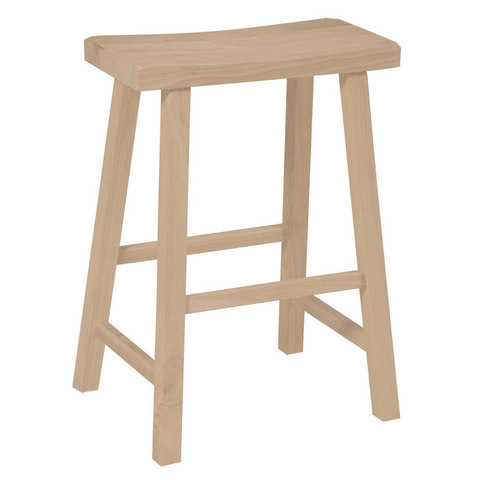
We knew we wanted barstools without a back. We loved the saddle stools at Pottery Barn but weren’t as in love with the hefty price tag. After looking around, we only found stools in colors that weren’t our top choices. It became clear that we should just paint some stools ourselves.

painted barstools

What you need:

Unfinished Wood Barstools—we scored two online for $50

Fine Sandpaper

Primer

Paint

Foam brush

Protective Top Coat

Plastic Covering and Painter’s Tape- only needed if you are doing a two-toned stool

Stain/Stain Rag- only needed if you are doing a two-toned stool


Step 1:

As your stools are unfinished, they should be pretty smooth and free of splintering wood. Give your stools a super light and casual sanding—just in case. We wanted a two-toned stool—wood stain on the seat and paint on the legs. Because of this, I used painter’s tape to cover up the saddle seat with part of a plastic drop cloth. Make sure it’s covered all the way so no primer gets through!

Barstool, unfinished Step 2:

Prime your stools (or, like in my case just prime the legs). For the first time ever, I used a spray primer. The spray primer went on great—very easy to use. Follow the directions on your primer can to ensure correct application. Let dry completely.

Step 3:

While my seat was still wrapped up, I painted the legs of my stool. I applied two coats of paint using a small foam brush. Let dry completely.

primed barstools

You can see the one stool has been painted, while the other one is primed and ready for some color. Pardon the mess!

Step 4:

With the stool legs completely painted and dry, I removed the plastic covering from the saddle seat. I wanted to stain the top of the seat a color that would closest match our hardwood floors. Minwax’s Natural color did the job. Follow the direction on the stain can for the correct application procedure. I did two coats of stain.

Step 5:

Apply your finish/top coat. Again, we went with a spray for this step and used two coats. Make sure you do this in a well ventilated area—it can get a bit stinky! Let dry completely.

painted barstools 2

We’re happy to finally have somewhere to sit!

Circles Circles on the Wall

One thing I’ve learned from endless hours spent watching HGTV is that a coat of paint is the easiest, quickest and cheapest way to refresh a space. Influenced by my favorite designers Candice Olsen and Sarah Richardson (Scott Magillvrary is easy on the eyes, I mean has nice designs, too), I like to create some drama and interest in a room by using patterns. I’ve painted wide horizontal stripes in our dinning room, thin vertical stripes in the powder room and circles in L’s nursery. The first two were nothing a little painter’s tape couldn’t handle. The circle pattern, however, proved to be a bit of a thinker, especially when I had the pregnancy fog.

I thought I would share how I created the graphic circle pattern.

DSC00409

Step 1: I hunted down some tools. A piece of string and two pencils will do the trick but conveniently I had a giant safety compass and chalk on hand. The perks of my job!

IMG_3523

Step 2: I measured the length and width of the wall and decided on the radius of the circles. Since I wanted a more graphic look, I needed the circles to be fairly large. I did some division using the length of the wall and went with 22 inches as the diameter (11 inches as the radius).

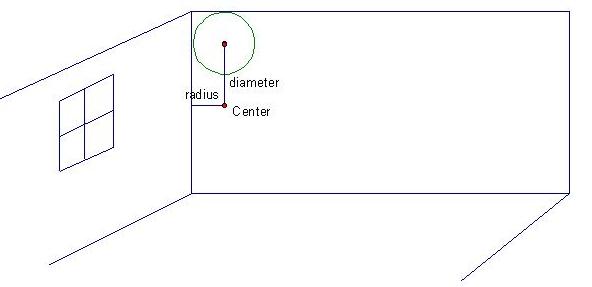
Step 3: I drew all of the outer circles starting from the upper left corner of the wall. Using the length of the radius, I measured 11 inches from the ceiling down and side in. The intersection point was the center of my first circle. I placed the center of my compass there and drew the circle.

circle step 1

For the second circle, I measured 22 inches down from the center of the first circle and 11 inches in from the wall. I marked that point then drew a circle. I repeated this process all the down to the bottom of the wall. The circles on the very bottom did not go all the way around. I didn’t mind since they were covered by furniture anyway.

paintcirlce3

I started the second column by measuring 22 inches (length of the diameter) to the right of the center of  first column, marked the center then drew the next circle. Things after this point were pretty systematic. It didn’t take long before all the outer circles were complete.

circle step 3

Step 4: This was the easy part. Using the already marked centers, I drew the inner circles. I made the radius of the inner circles 2 inches shorter creating a band between the circles.

circle step 4

Step 5: I painted the space between the outer and inner circles with a small paint brush. Whenever I “colored outside of the lines”, I used a little wall paint to fix the spot.

Nursery1

There are probably more efficient ways to create this patten, but this approach worked for me. Have you painted any patterns? Or are you thinking of creating a pattern on your wall? Share your projects and ideas with us. We’d happy to help you figure out the math too.

1 10 11 12 13 14 19